Écorcheurs! Rulebook – Skirmish Wargaming in the Hundred Years War
Écorcheurs! Rulebook – Skirmish Wargaming in the Hundred Years War
Brought to you by Robert W. Jones in association with Gripping Beast
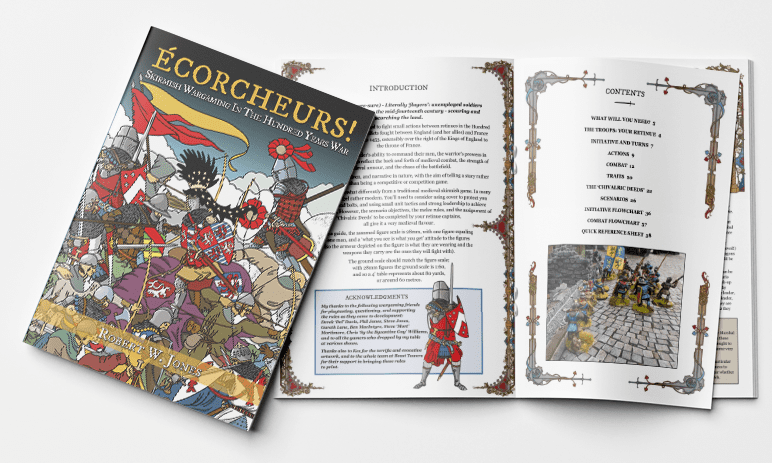
Écorcheurs! is a new set of skirmish rules developed to fight small actions between retinues in the Hundred Years War – the series of conflicts fought between England (and her allies) and France (and her allies) from 1337 to 1453, ostensibly over the right of the kings of England to the throne of France.
• Ideal for smaller tables, and between 20 and 40 15mm to 28mm figures per side.
• Scenario-driven and narrative in nature.
• Focus on the leader’s ability to command, and the warrior’s prowess in combat.
• Innovative melee rules that reflect the back and forth of medieval combat, the strength of armour, and the chaos of the field.
• Rewards tactical thinking, and encourages a chivalric mindset.
Rulebook will provide the rules, suggested retinues, as well as scenarios and a mini-campaign centred on Edward III’s 1346 campaign, the one that led to the battle of Crécy.
Every wargamer has a ruleset in them, just like everyone has a novel. What does the author, Rob W. Jones bring to these rules?
“I’m a historian by trade and inclination, and I’ve been thinking about medieval warfare for a very long time now, especially the business of how medieval warriors thought as much as how they fought. I’ve published books and articles, taught courses, and given lectures on the subject. I’m also a living historian/costumed interpretor/reenactor and have my own fourteenth-century harness.
“If you’re interested you can find out more about me on my personal website www.historianinharness.com
“All of that reading, research, and thinking has gone into these rules, to create something that I think has a flavour of medieval warfare, at least as I understand it.
However, I have been a wargamer longer than I have been a historian, and I am painfully aware that rules that strive to simulate a period’s warfare often does so at the cost of the fun of the game (and often falls short). I hope that I have balanced the desire for ‘accuracy’ with the requirement for entertainment, so that Écorcheurs! offers the best of both worlds.”
GAME F.A.Q
I’ve played with four people around a 4 foot square table and forty figures per side (each player controlling a Company of 20 men) and got a good result in a couple of hours. Bigger than that and things would need careful managing to ensure that players didn’t spend too long watching other people play, but wouldn’t be impossible.
Similarly, if your collection is for an earlier conflict – say 1066 or the Barons’ Wars – the rules will work. A ‘Fully-Armoured’ combatant could equally well be covered head-to-toe in mail as in plate, and a bow is a bow (as long as you aren’t trying to pitch fourteenth-century warbows against eleventh-century archers, but that would just be silly). Some of the traits might be a little different, and you may want to think of your own version of the ‘Chivalric Deeds’; it is these that give the figures their character and add much period flavour to the game.
I have already begun work on a supplement for the Wars of the Roses, which will offer ‘Chivalric Deeds’, ‘Traits’, characters, and scenarios specific to that conflict (including a campaign based around the vicious street fights at the first battle of St Albans). I also have more vague plans for covering earlier and later conflicts too.
However, I’ve found that introducing the icon dice does something to wargamers’ brains. When playing with them even the more competitive gamer stops trying to calculate the odds, stops asking ‘what do I need to roll?’, and becomes more enmeshed within the storytelling. It’s a fascinating bit of wargaming psychology!
Écorcheurs! is a new set of skirmish rules developed to fight small actions between retinues in the Hundred Years War – the series of conflicts fought between England (and her allies) and France (and her allies) from 1337 to 1453, ostensibly over the right of the kings of England to the throne of France.
• Ideal for smaller tables, and between 20 and 40 15mm to 28mm figures per side.
• Scenario-driven and narrative in nature.
• Focus on the leader’s ability to command, and the warrior’s prowess in combat.
• Innovative melee rules that reflect the back and forth of medieval combat, the strength of armour, and the chaos of the field.
• Rewards tactical thinking, and encourages a chivalric mindset.
Rulebook will provide the rules, suggested retinues, as well as scenarios and a mini-campaign centred on Edward III’s 1346 campaign, the one that led to the battle of Crécy.
Every wargamer has a ruleset in them, just like everyone has a novel. What does the author, Rob W. Jones bring to these rules?
“I’m a historian by trade and inclination, and I’ve been thinking about medieval warfare for a very long time now, especially the business of how medieval warriors thought as much as how they fought. I’ve published books and articles, taught courses, and given lectures on the subject. I’m also a living historian/costumed interpretor/reenactor and have my own fourteenth-century harness.
“If you’re interested you can find out more about me on my personal website www.historianinharness.com
“All of that reading, research, and thinking has gone into these rules, to create something that I think has a flavour of medieval warfare, at least as I understand it.
However, I have been a wargamer longer than I have been a historian, and I am painfully aware that rules that strive to simulate a period’s warfare often does so at the cost of the fun of the game (and often falls short). I hope that I have balanced the desire for ‘accuracy’ with the requirement for entertainment, so that Écorcheurs! offers the best of both worlds.”
GAME F.A.Q
How does the game handle multiplayer games (if at all)?
There are rules for ensuring that no one player hogs all the glory and honour. It’s a skirmish game, so individual forces are small.I’ve played with four people around a 4 foot square table and forty figures per side (each player controlling a Company of 20 men) and got a good result in a couple of hours. Bigger than that and things would need careful managing to ensure that players didn’t spend too long watching other people play, but wouldn’t be impossible.
All the figures I’m seeing suggest it’s aimed at the early period ~1350. What are the rules like for the later period post 1400?
You are right that the focus of the scenarios to be included is 1346 and the Crécy campaign. However, I see nothing in the way war at this level was conducted that would mean the rules couldn’t be used as they are for anything up to the middle of the fifteenth century without any major changes.Similarly, if your collection is for an earlier conflict – say 1066 or the Barons’ Wars – the rules will work. A ‘Fully-Armoured’ combatant could equally well be covered head-to-toe in mail as in plate, and a bow is a bow (as long as you aren’t trying to pitch fourteenth-century warbows against eleventh-century archers, but that would just be silly). Some of the traits might be a little different, and you may want to think of your own version of the ‘Chivalric Deeds’; it is these that give the figures their character and add much period flavour to the game.
I have already begun work on a supplement for the Wars of the Roses, which will offer ‘Chivalric Deeds’, ‘Traits’, characters, and scenarios specific to that conflict (including a campaign based around the vicious street fights at the first battle of St Albans). I also have more vague plans for covering earlier and later conflicts too.
Do I have to use the Combat Dice?
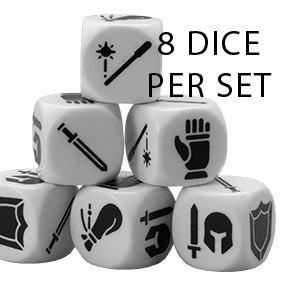
You can fight out melee and shooting combat using ordinary d6s. The tables in the rulebook assign a numerical value to each of the icons for just that purpose.However, I’ve found that introducing the icon dice does something to wargamers’ brains. When playing with them even the more competitive gamer stops trying to calculate the odds, stops asking ‘what do I need to roll?’, and becomes more enmeshed within the storytelling. It’s a fascinating bit of wargaming psychology!
$22.50
Out of stock
SKU: GB ECOR01
Related products
-

Écorcheurs! Dice
$18.00Add to WishlistAdd to Wishlist -
Écorcheurs! Tokens
$18.00Add to WishlistAdd to Wishlist